
Home / Functional Hallux Limitus / Understand / Biomechanics
Understand
Biomechanics of FHL: the tenodesis effect and the cascade
The blocked gliding of the tendon turns the foot into a taut cord with every step. This mechanism, the tenodesis effect, reverses the physiological role of the big toe and spreads the imbalance through the entire chain, from the foot to the lumbar spine, across five successive levels.
Understand
The central concept
The inability of the FHL tendon to glide freely in the retro-talar tunnel turns a physiological mechanism into a pathological one. With each step, when the ankle moves into dorsiflexion, the blocked tendon behaves like a taut cord beneath the sole of the foot. This is what we call the tenodesis effect, the central concept that sums up the entire FHL condition.
Key concept
Tenodesis effect
A taut-cord effect created by a tendon that can no longer glide within its tunnel. Instead of relaxing passively, it automatically comes under tension with every movement of the joint located upstream. In FHL, the tenodesis effect forces the big toe into plantarflexion at the very moment it should be in dorsiflexion, and locks the subtalar joint in varus.
What should happen: the Hicks windlass mechanism
Before understanding what FHL throws off course, we need to understand what the foot does normally. In 1954, Hicks described a fundamental physiological mechanism he named the Windlass Mechanism, or windlass effect. This mechanism is essential to propulsion and to the synchronism of the entire lower limb.
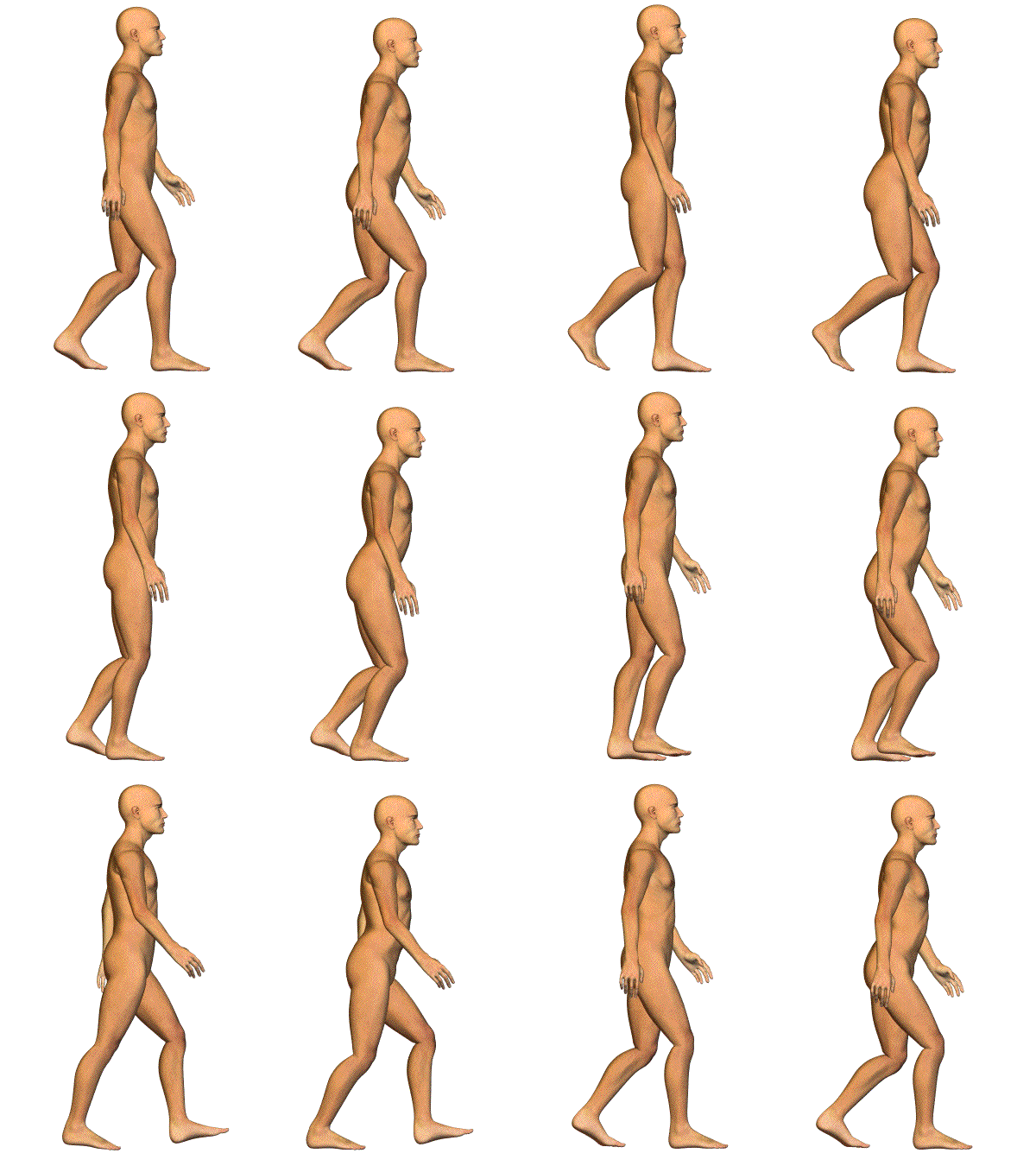
During propulsion, the big toe moves into dorsiflexion. This dorsiflexion tightens the plantar fascia, which winds around the head of the first metatarsal the way a rope winds around a windlass. This winding deepens the arch of the foot, turns the foot into a rigid lever, and triggers a cascade of coordinated movements: a shift from pronation to supination, external tibial rotation, and optimal positioning of the knee and hip for propulsion.
Normal windlass mechanism versus pathological tenodesis effect
FHL literally reverses the mechanism. Instead of winding up the plantar fascia to create a rigid lever, the blocked tendon passively pulls the big toe into plantarflexion. The side-by-side comparison makes the difference striking.

Physiological mechanism
Hicks windlass mechanism, 1954
The big toe rises into dorsiflexion, the plantar fascia winds around the metatarsal, the arch deepens, and the foot becomes a rigid propulsive lever. Pronation shifts into supination, the leg moves into external rotation, and the knee and hip position themselves for propulsion.
Pathological mechanism
Tenodesis effect of FHL
The blocked tendon pulls the big toe into plantarflexion instead of letting it rise. The windlass mechanism no longer operates, the arch stays flat, and the foot does not become the expected rigid lever. Propulsion is disorganized, synchronism is broken, and the pathological cascade begins.
The exact moment of the conflict
This tenodesis effect occurs at the end of the stance phase, just before propulsion, when the ankle reaches its maximum dorsiflexion. It is precisely at this moment that the tendon should glide freely, and precisely at this moment that it jams.
The broken physiological synchronism
In normal walking, the windlass mechanism triggers a synchronous chain of coordinated movements. Each joint passes the information to the next, creating a smooth and economical mechanism. FHL breaks this chain at the very first link.
Normal synchronous chain
Four coordinated movements at propulsion
Dorsiflexion of the big toe
The big toe rises naturally in late stance
Tensioning of the plantar fascia
The fascia winds up, the arch deepens
Pronation to supination
The foot shifts into supination and becomes rigid
External tibial rotation
The leg rotates, optimal knee position
With FHL, step 1 does not occur. Dorsiflexion of the big toe is prevented by the tenodesis effect. The entire physiological cascade fails, and the whole lower limb has to improvise compensations.
The immediate downstream consequences
Even before travelling up the chain, the tendon blockage has direct consequences where the tendon passes between the sesamoids and at the metatarsophalangeal joint of the big toe.
The double local impact
The bowstring effect shifts the sesamoid sling toward the second metatarsal, which predisposes to hallux valgus. And it increases compressive stress on the metatarsophalangeal joint, which predisposes to hallux rigidus. Two common conditions of the big toe whose biomechanical origin traces back to the retro-talar tunnel.
The complete biomechanical cascade, from foot to back
Beyond the forefoot, FHL echoes throughout the entire lower limb and all the way to the lumbar spine. Five levels of impact in a chain, each with its own characteristic conditions.
Hallux and plantar arch
Predisposition to hallux rigidus, hallux valgus, collapse of the plantar arch (flatfoot) and stress fractures. The subtalar joint locks in varus, and the foot loses its ability to adapt to the ground.
Initial contact in excessive supination
The instability at heel strike promotes sprains, particularly recurrent sprains. The mechanism is the loss of the subtalar joint’s ability to adjust to variations in the ground.
Overload tendinitis and ligament injuries
The increased varus moment at initial contact tensions the lateral tension band, stressing the iliotibial band. The associated external rotation places the pes anserinus tendons under eccentric contraction. The abrupt shift into pronation in late stance predisposes to rupture of the anterior cruciate ligament.
Femoroacetabular impingement and pelvic tilt
Weakening of the gluteal lever arm leads to an anterior pelvic tilt. Knee valgus (medial collapse) places the hip in excessive internal rotation, increasing the risk of femoroacetabular impingement and premature joint wear.
Chronic postural low back pain
The forward projection of the trunk, as documented by Howard Dananberg in his seminal 1993 articles, imposes a permanent contraction of the erector spinae. The lordosis increases, and the thoracolumbar junction becomes a point of chronic tension.
« The inter-joint synchronism governed by the coxa pedis is what makes human walking so economical. When FHL breaks this synchronism, the entire body works harder to move less well. »
Dr Jacques Vallotton, Centre Orthopédique d’Ouchy
Key scientific article
The tenodesis effect at the retro-talar pulley was formally described in an international publication in 2010, which stands as the reference on the biomechanical mechanism of FHL.
Foundational article
Functional Hallux Limitus or Rigidus Caused by a Tenodesis Effect at the Retrotalar Pulley
Vallotton J., Cheverri S., Dobbelaere-Nicolas V., 2010, American Journal of Podiatry, vol. 100, no. 3, pp. 220–229
Understand through video
Several video sequences illustrate the mechanism of the tenodesis effect, from biomechanical analysis on a treadmill to the scientific lectures of the Medicol Congress.
Biomechanical consequences of functional hallux limitus
Functional Hallux Limitus — Form and Function
Functional hallux limitus (FHL): involvement of FHL in gait and posture disorders
Biomechanics of running
Medicol Congress 2023 — Biomechanics and consequences for locomotion
Next step
Demonstrating FHL in your patient
Biomechanics explains the mechanism. The clinical tests make it possible to demonstrate it objectively in the office, in less than a minute, with no special equipment.
In brief
Normal mechanism
windlass mechanism
FHL mechanism
tenodesis effect
Historical reference
Hicks 1954
FHL reference
2010
Moment of the conflict
late stance phase
Levels affected
5, from foot to back
Go further
Related pages
Anatomy of the tunnel
A detailed look at the retro-talar tunnel and the five anatomical variations that predispose to the conflict.
Clinical tests
The FHL stretch test to reveal the tenodesis effect in the office, in less than a minute.